


Procurement Guide of Wireless Palm Doppler Ultrasound for Clinics and Medical Institutions
- 2026-08-12
- 982
- Guangzhou Sonostar Technologies Co., Limited
Point-of-care ultrasound (POCUS) has become a standard auxiliary diagnostic tool for outpatient clinics, primary care centers and specialist departments. Wireless palm Doppler ultrasound expands bedside diagnostic capacity without occupying fixed space like cart-based ultrasound systems. For clinic procurement teams, purchasing this device requires balancing clinical imaging requirements, infection control, data interoperability and long-term operational costs, rather than only comparing upfront prices. This guide summarizes practical evaluation indicators for medical purchasers, based on international POCUS clinical recommendations and real-world primary care deployment experience
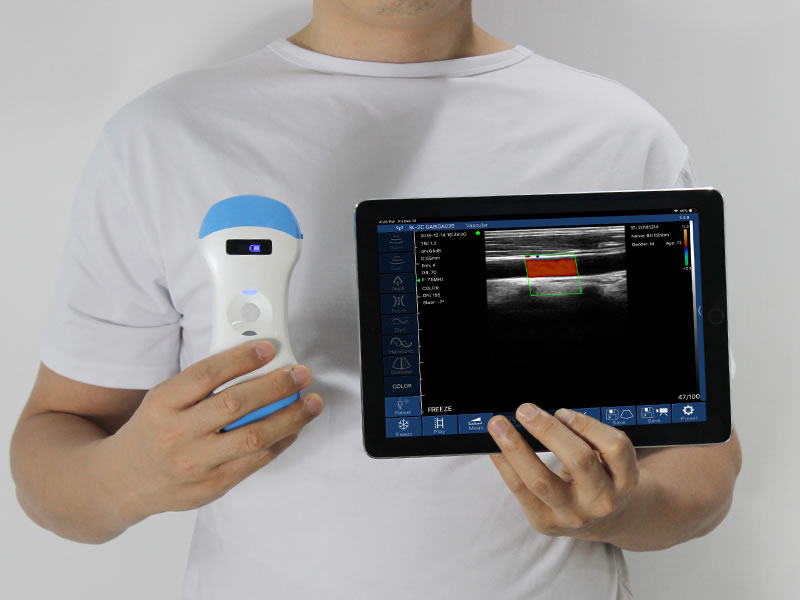
Sonostar’s wireless palm Doppler ultrasound is designed for routine bedside Doppler examinations, vascular access guidance and superficial tissue assessment, supporting multiple probe configurations to match daily workflows in general clinics, anesthesia departments and wound care units.

Match Doppler Imaging Performance With Your Clinical Scenarios
Doppler function is the core assessment item, including color Doppler, power Doppler and pulsed-wave Doppler. Clinics focusing on vascular puncture, peripheral vascular screening and superficial tissue evaluation need stable blood flow signal display and acceptable near-field resolution. Purchasers should confirm whether the device supports adjustable Doppler scale, filter and gain to reduce motion artifacts during ward rounds or emergency examinations. Primary care clinics with limited budgets may prioritize basic color Doppler for venous and arterial screening; anesthesia and pain management clinics need clearer needle visualization under Doppler guidance for vascular access and nerve block operations.
Verify Wireless Transmission Stability & Terminal Compatibility
As a wireless handheld device, reliable signal connection directly affects clinical continuity. Key evaluation points include Wi-Fi working distance, anti-interference performance in dense medical equipment environments, and compatible operating systems (iOS, Android, Windows). Many clinics integrate POCUS images into electronic medical records or PACS systems; confirm DICOM output capability before purchase to avoid isolated image files that cannot be archived formallyPMC. Devices with replaceable batteries are preferred for multi-room rounds or mobile community screening, reducing interruptions caused by power shortage during continuous shifts.

Infection Control & Clinical Disinfection Adaptability
Clinic settings require frequent probe contact with skin and mucosa. The procurement checklist must cover probe material compatibility with high-level disinfectants, sealed housing design and smooth surface without gaps that accumulate contaminants. Infection control protocols for handheld ultrasound transducers follow standard reprocessing requirements to lower cross-infection risks between patients.
Avoid models with fragile outer coatings that degrade after repeated disinfection, which increases maintenance expenses and safety risks in long-term use.

Probe Combination & Expandability
Many clinics need multi-scenario use with limited procurement budgets. Common options include single-probe basic versions and multi-in-one configurable schemes (linear, convex array probes). Linear high-frequency probes suit peripheral vessels, nerves and musculoskeletal exams; convex probes apply to abdominal and pelvic screening. Before ordering, list your regular examination types to avoid overbuying unnecessary probes or lacking the required transducer for core clinical work.

Training, Warranty & After-Sales Service
Hardware alone cannot guarantee stable clinical application. Formal vendor training for operators, quality assurance mechanisms and clear warranty terms are essential parts of medical procurement. International POCUS guidelines require credentialing and regular competency review for clinicians using handheld ultrasound devicesACEP. Evaluate warranty duration, on-site service response cycle, software upgrade policy and spare parts supply cycle. Long-term cost should include maintenance, probe replacement and clinical training, not only the initial purchase price.
Compliance & Medicolegal Considerations
Medical ultrasound equipment for clinical use must meet local medical device regulatory requirements. Image traceability, patient data encryption and HIPAA/GDPR-compliant transmission are critical for clinics storing diagnostic records. Private or departmental procurement of handheld ultrasound should obtain institutional bioengineering, IT and risk management approval before clinical deployment.

FAQ
Q1: What is the biggest difference between wireless palm Doppler ultrasound and traditional cart Doppler ultrasound for clinics?
Wireless palm Doppler ultrasound supports mobile bedside scanning with lower space occupation, while cart systems provide stronger deep-tissue imaging performance for complex diagnostic work. Most primary clinics adopt handheld models for routine vascular and superficial POCUS tasks.
Q2: Must a wireless palm Doppler ultrasound support DICOM and PACS connection?
It depends on your hospital record-keeping rules. Facilities requiring formal image archiving and radiology review should prioritize DICOM-compatible devices; small independent clinics for quick bedside screening can adopt simplified image export schemes.
Q3: What battery design is more suitable for continuous clinic shifts?
Replaceable battery design is more suitable for multi-patient continuous rounds and mobile community screening than built-in non-detachable batteries.
Summary
When clinics and medical institutions select wireless palm Doppler ultrasound, prioritize matching Doppler imaging capacity to daily examination needs, wireless stability, disinfection suitability, probe expandability, DICOM interoperability and complete training & warranty support. Reasonable procurement planning helps expand POCUS capacity while controlling long-term operational risks.
References
1. American College of Emergency Physicians. Appropriate Use Criteria for Handheld/Pocket Ultrasound Devices. ACEP Policy Statement, 2018ACEP.
2. Moore CL, et al. Time to establish pillars in point‐of‐care ultrasound. Journal of Ultrasound in Medicine, 2021PMC.
3. Vegas A, et al. Guidelines for performing ultrasound-guided vascular cannulation. Journal of the American Society of Echocardiography, 2025.




 Home
Home Product
 News
News Contact