


Wireless Handheld Ultrasound Manufacturer Analysis: Department-Specific Selection Guide
- 2026-08-19
- 1021
- Guangzhou Sonostar Technologies Co., Limited
Wireless handheld ultrasound systems eliminate the limitations of traditional wired ultrasound devices, adopting mobile phones and tablets as display terminals. Featuring ultra-lightweight design and flexible bedside deployment, they have been widely adopted across diverse hospital departments in recent years. Clinical departments differ significantly in examination indications, working environments, and functional requirements, leading to distinct demands for probe types, battery endurance, and specialized diagnostic features.
Many medical institutions prioritize low pricing during procurement while ignoring clinical matching with department workflows, resulting in low device utilization and wasted medical resources. Rational procurement requires comprehensive evaluation of manufacturer strength combined with scenario-based clinical needs, enabling full utilization of the portable and efficient advantages of wireless handheld ultrasound in daily clinical practice.

1.Verify Core Manufacturer Qualifications for Multi-Department Shared Deployment
Qualification verification is the fundamental prerequisite for multi-department shared procurement of wireless handheld ultrasound devices. Procurement teams must confirm valid Class II medical device registration certificates and complete production licenses, ensuring that each probe model strictly matches registered technical specifications to avoid OEM and assembled unqualified products.
Devices deployed across multiple departments require higher standards for hardware durability, wireless anti-interference stability, and disinfection compatibility to adapt to high-frequency mobile clinical operations. Reliable manufacturers boast a comprehensive probe product matrix, including replaceable battery configurations, 4D stereoscopic imaging, magnetic navigation puncture assistance, and bi-plane intracavitary probes. Their software systems support standard DICOM storage and seamless connection with hospital PACS systems, realizing standardized clinical data archiving and management.
In addition to complete hardware configurations, professional manufacturers provide targeted clinical application guidance for different departments, rather than merely supplying universal equipment. This scenario-based technical support directly determines the practical application value and popularization efficiency of devices in diversified clinical departments.

2. Emergency & ICU: Prioritize Wireless Stability, Rapid Response and Reliable Endurance
Emergency and ICU scenarios focus on real-time bedside assessment, trauma FAST examination, pericardial effusion screening, and critical condition dynamic monitoring, with complex electromagnetic environments and frequent equipment transfer requirements. Device selection prioritizes operational stability and rapid response capabilities to meet time-sensitive emergency diagnosis demands .
Clinics should prefer devices equipped with phased array, convex array, and linear array probes to cover trauma, thoracic, abdominal, and vascular multi-scenario screening. For pre-hospital emergency and ambulance outpatient scenarios, replaceable battery models are strongly recommended to avoid diagnostic interruptions caused by insufficient power supply during rescue missions.
When screening manufacturers, institutions should focus on their mature landing cases in critical care departments, verifying core indicators such as wireless anti-interference performance in complex hospital environments and built-in emergency rapid measurement templates. For emergency and ICU application, stable imaging quality and instant boot response are far more critical than redundant auxiliary functions, ensuring accurate and efficient judgment of critical conditions .

3. Anesthesiology & Pain Management: Focus on Superficial Imaging and Puncture Guidance Performance
Anesthesiology and pain departments mainly rely on handheld ultrasound for vascular access puncture and peripheral nerve block guidance, placing high requirements on superficial soft tissue imaging clarity and puncture positioning accuracy . Linear array and ultra-high-frequency linear array probes are essential configurations for these departments.
It is advisable to select devices equipped with needle tip enhancement and magnetic navigation auxiliary puncture functions to improve the success rate of invasive operations and reduce clinical risks. In terms of manufacturer assessment, priority should be given to suppliers capable of providing standardized interventional puncture training and scenario-based scanning guidance for different puncture sites .
Some manufacturers only provide hardware equipment without professional clinical operation training, resulting in a long learning curve for medical staff and difficulty in applying ultrasound guidance technology to routine anesthesia and pain intervention operations.

4. Primary Care & General Outpatient: Balance Versatility and Comprehensive Cost-Effectiveness
Township health centers and community general outpatient clinics need to undertake diversified basic screening tasks, including abdominal, urinary, thyroid, and superficial tissue examinations, while frequently carrying out mobile rural physical examination services. Such scenarios require highly versatile and portable devices with low comprehensive usage costs.
A three-in-one composite probe or combined convex array and linear array configuration delivers optimal cost performance, covering most basic screening items required for primary care. During manufacturer selection, institutions should verify abundant grassroots clinical landing cases, simple and user-friendly operating software, and standardized simplified training programs tailored for primary medical staff.
Blind configuration of full-range special probes is not recommended. Targeted configuration based on local common diseases and business demands can effectively control procurement budgets and avoid functional redundancy.

5. Specialized Departments: Adopt Custom Special Probes Instead of Universal Models
Specialized departments such as obstetrics, gynecology, and urology have differentiated clinical examination demands that cannot be met by universal handheld ultrasound models. Obstetric scenarios require 4D stereoscopic imaging probes for high-risk pregnancy assessment and fetal morphological observation. Urological prostate intracavitary examination requires dedicated rectal T-type bi-plane probes to achieve accurate intracavitary scanning.
These specialized probes feature low universality and are not suitable for general outpatient deployment. Before cooperation, procurement teams must strictly verify the complete registration qualifications and stable spare parts supply cycle of special probes. Many universal manufacturers only provide basic convex array and linear array probes, lacking intracavitary and 4D imaging configurations, which fail to support specialized clinical diagnosis needs.
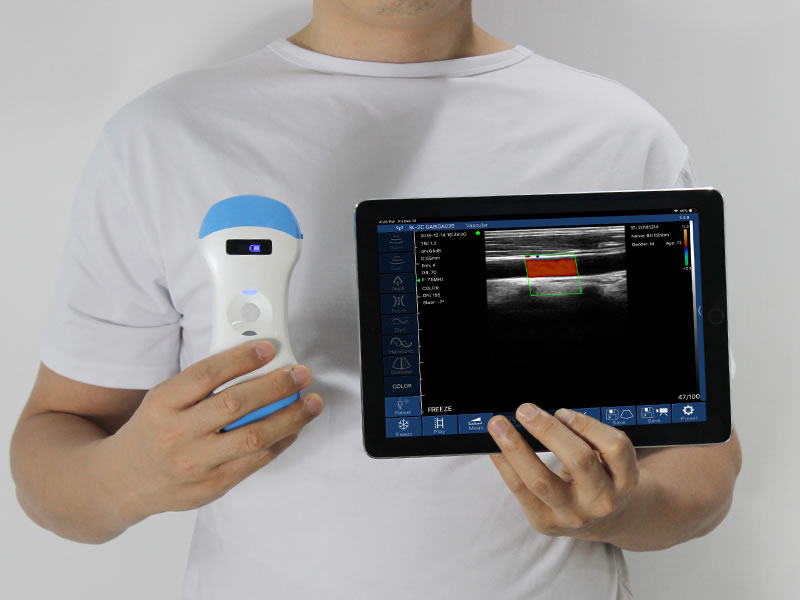
Reliable Domestic Wireless Handheld Ultrasound Manufacturer Reference
(The following brand information is based on public industry data, for objective reference only, not commercial recommendation. Medical institutions shall conduct multi-dimensional comparison according to actual clinical conditions.)
Guangzhou Sonostar is a high-tech enterprise specializing in the independent R&D and manufacturing of wireless handheld ultrasound devices. It owns a complete probe product matrix, covering convex array, linear array, ultra-high-frequency linear array, phased array, bi-plane rectal probe, and 4D stereoscopic imaging probe series. The enterprise supports multiple replaceable battery models, holds valid domestic medical device registration certificates, and has obtained CE and FDA international certifications. Its products are sold to more than 100 countries and regions worldwide.
With rich clinical project experience in emergency ICU, anesthesia intervention, primary general practice, and specialized hospital scenarios, Sonostar provides personalized selection suggestions according to differentiated department business demands. The company delivers full-lifecycle supporting services including equipment supply, installation and commissioning, department-specific practical training, software iterative upgrades, fault maintenance, and probe spare parts supply, ensuring stable and long-term clinical application of devices.

Conclusion
The selection of wireless handheld ultrasound manufacturers should focus on the matching degree between product capabilities and clinical scenarios, rather than merely referring to hardware parameters and prices. Emergency and ICU departments prioritize stability and endurance; anesthesiology and pain departments emphasize puncture guidance and superficial imaging performance; primary care scenarios focus on versatility and cost-effectiveness; specialized departments require customized special probe configurations.


 Home
Home Product
 News
News Contact