


Types of Pocket Ultrasound Stethoscope: Wireless, Wired and Integrated Designs Compared
- 2026-09-10
- 30
- Guangzhou Sonostar Technologies Co., Limited
A pocket ultrasound stethoscope is not one device architecture. The T/CSBME group standard Technical Specifications and Applications of Handheld Ultrasound (Ultrasonic Scope)—drafted with participation from clinician centers, research institutes and the Guangzhou manufacturer SonoStar—splits the category into three form factors by the connection between probe and screen: wireless, wired, and integrated. The label on the box can mislead: some "USB probes" are in fact wireless. The real dividing line is whether a physical cable runs between the probe and the display, because that single fact distributes weight, power and failure points differently and changes the daily workflow long after purchase.
1. The Standard's Classification Logic
The T/CSBME definitions are precise. A wireless unit transmits scan images from the probe to a separate display—phone, tablet or computer—without a physical cable. A wired unit connects probe to display by cable. An integrated unit builds probe-side hardware and screen into one structure.
All three still fall under the same physical definition: smartphone-sized scale, 80–300 g class, 2–8 hours of battery runtime, −5 °C to 40 °C operating range, and identical safety obligations under the GB 9706.1 and GB 9706.237 equivalents of IEC 60601, including normal operation after three continuous scanning hours. Form factor changes how the device is carried and powered; it does not relax what it must pass.
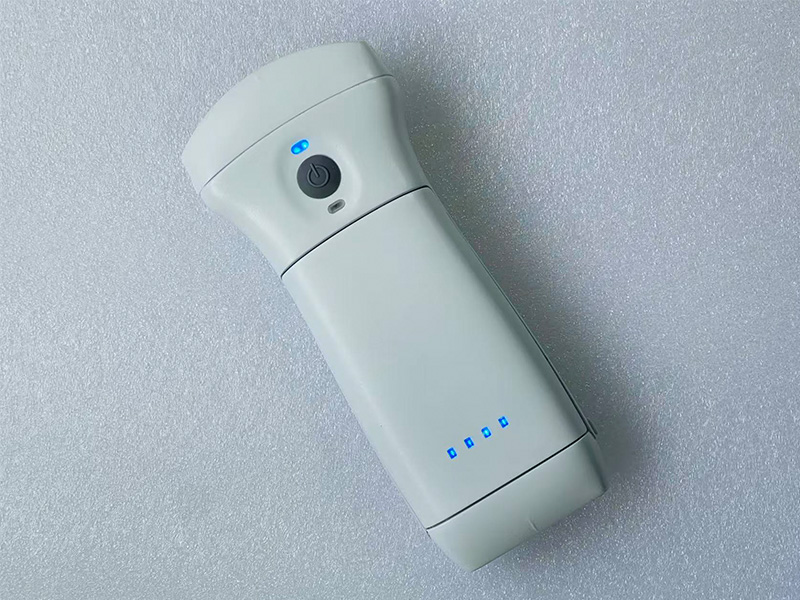
2. Wireless Form Factor: The Computer Moves Into the Probe
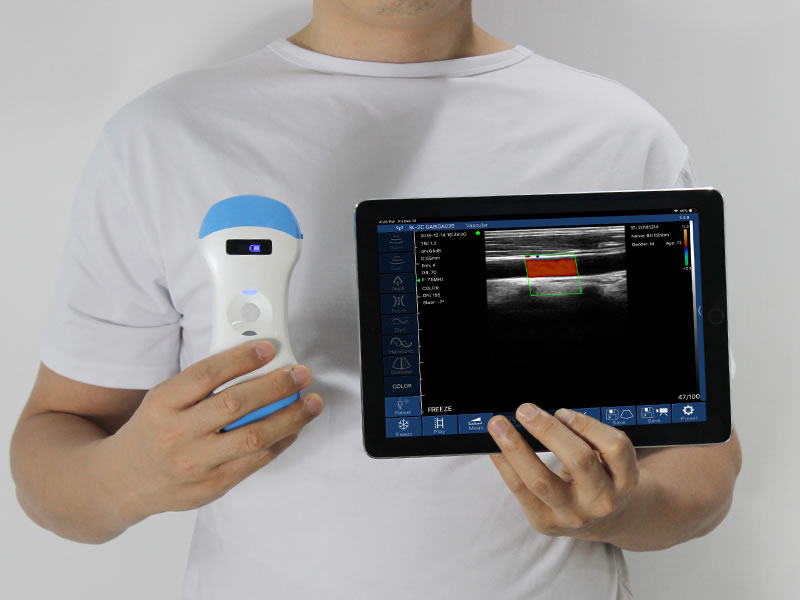
In the wireless design, the probe itself contains the beamforming electronics, battery and radio, while the screen belongs to a separate terminal. It ships in two distinct connection schemes.
Direct Wi-Fi pairing. The probe creates its own Wi-Fi network and pairs directly with a phone or tablet. SonoStar's 9CPL three-in-one probe is representative: 192 elements and 64 channels across convex 3.2/5.0 MHz (to 305 mm), linear 7.5/10.0 MHz (20–80 mm) and phased-array modes, around 200 g, roughly 10 frames per second to iOS, Android or Windows, with a swappable battery for continuous rounds. No external network is involved.
USB-receiver pairing. The probe is still cable-free and battery-powered, but it links to a small USB receiver plugged into a computer rather than pairing over the terminal's Wi-Fi—this exists for desktop PCs, locked-down workstations and environments where direct Wi-Fi pairing is restricted. SonoStar's 3C convex probe follows this scheme: despite the "USB probe" product name, the probe weighs only 120 g at 11 × 5 × 1.8 cm, runs on an internal battery (about 1 hour per charge), streams at 18 frames per second, and carries 80 elements and 16 channels at 3.2/4 MHz with depths to 240 mm. Nothing trails from the probe to the screen; it is a wireless device whose receiver happens to be a USB dongle.
The common payoff is that only the probe is held, no cable crosses a sterile field, and one probe can serve several display terminals. The shared trade-offs: probe batteries must be charged and maintained, delivery depends on a stable radio link, and packing electronics plus battery into a sealed 120–200 g housing caps channel count and heat dissipation compared with larger systems.
3. Wired Form Factor: A Cable Carries Data and Power
The T/CSBME wired design runs a physical cable between a screenless probe and its display terminal, which also typically supplies power. The probe needs no battery, so the hand-held part is lighter and carries no charging routine; the physical link has zero pairing failure and no radio latency. Those advantages are real, which is why the architecture persists in some early-generation and OEM handheld designs.

Its costs are equally structural: the cable itself is a snag and disinfection weak point at the bedside, the connector wears over thousands of insertions, and movement radius is limited by cable length. Mainstream current pocket product lines have largely moved to the wireless architecture, so buyers comparing current-generation devices will encounter this form factor mostly in legacy or custom-OEM offerings—and should not confuse a wireless USB-receiver probe with a genuinely wired one.
4. Integrated Form Factor: Screen and Probe in One System
The integrated design merges display, host computer and probe connector into a single portable instrument, closer in logic to a compact cart system. SonoStar's SS-10 pairs a 15-inch LED display with multiple swappable probes, roughly 4 hours of internal battery and USB storage; the smaller V6 uses a 5.6-inch screen, a multi-frequency probe, 8 GB internal storage and a fully waterproof housing.
Its strength is self-containment: it boots on its own, requires no personal phone, asks nothing of a bring-your-own-device policy, and can host several dedicated probes for shared departmental use. Its cost is size and weight—the hand-held part is no longer pocket-class—and a single-screen architecture cannot split a probe operator from a remote reviewer the way a wireless-plus-tablet setup can.
5. Side-by-Side Comparison
| Probe-to-screen link | Internal Wi-Fi, no cable | Wireless to USB dongle in PC | Physical cable | Internal, same enclosure |
| Hand-held part | ~200 g, battery inside | ~120 g, battery inside | Lighter, no battery | Several hundred g+ total |
| Display | Own phone/tablet | PC/workstation via dongle | Tethered terminal | Built-in screen |
| Best matched to | Mobile rounds, multi-user pairing | Locked-down PC environments | Legacy/OEM fixed setups | Shared room, multi-probe department |
| Main maintenance point | Battery, radio pairing | Battery, dongle, driver | Cable, connector wear | Screen, host, battery |
6. What Form Factor Does Not Tell You
Three misconceptions are worth rejecting explicitly. First, form factor is not a performance ranking: the wireless 9CPL's 192 elements and 64 channels out-specify the equally wireless 3C's 80 elements and 16 channels—the gap reflects generation and product tier, not connection type, and "integrated looks professional" cannot reverse element-and-channel arithmetic. Second, the "USB" in a product name is not evidence of a wired device; only the presence or absence of a physical probe-to-screen cable decides the category. Third, none of the three escapes the standard's image quality-control requirements—clear grayscale layers, color flow without bleed-out, complete spectral envelopes—or its safety certification path. The correct procurement question is who scans, where, on which approved terminal, and who maintains the device.
Conclusion
The three pocket ultrasound stethoscope form factors represent three bargains. Wireless—whether direct-to-phone or through a USB receiver—puts the computer in a 120–200 g battery-powered probe and buys cable-free mobility at the price of battery and radio management. Wired keeps the probe simplest at the price of a tether and now survives mainly in legacy designs. Integrated delivers self-contained, multi-probe operation at the price of pocket-class size. The T/CSBME standard holds all three to the same safety, runtime and image-quality bar, so the decision should follow workflow and terminal reality, not assumptions about which architecture sounds newer.
Disclaimer: This article is for medical device technology education only and does not constitute clinical diagnostic or procurement guidance. Standard text is cited for technical reference; specifications are subject to manufacturers' official documentation, and deployment must follow institutional protocols and applicable regulations.
References
[1] Chinese Society of Biomedical Engineering. Technical Specifications and Applications of Handheld Ultrasound (Ultrasonic Scope) (T/CSBME group standard), National Group Standard Information Platform, 2023.
[2] EFSUMB Position Paper on the Use of Handheld Ultrasound Devices in Clinical Practice, 2019.
[3] Szabo TL. Diagnostic Ultrasound Imaging: Inside Out. 2nd ed. Academic Press (Elsevier), 2014.
[4] SonoStar official specifications: 9CPL and 3C wireless probes, SS-10 and V6 integrated systems.



 Home
Home Product
 News
News Contact