


Wireless Bladder Scanner: Accurate, Portable Bladder Volume Measurement Without a Cart
- 2026-10-08
- 53
- Guangzhou Sonostar Technologies Co., Limited
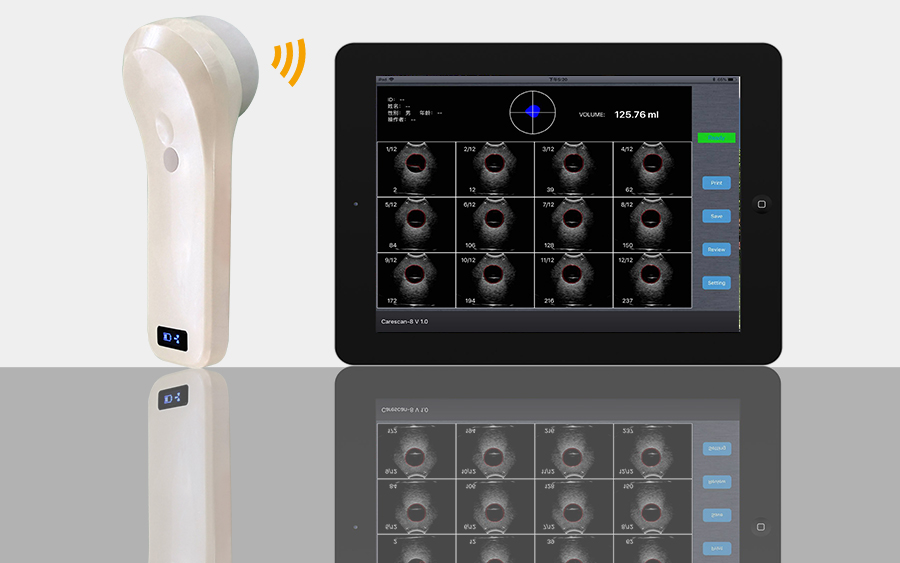
If your clinic still wheels a cart-based ultrasound console from room to room to check bladder volume, a wireless bladder scanner changes the workflow. It is a pocket-size probe that streams a live ultrasound image to a clinician's phone or tablet over its own Wi-Fi — no screen on the device, no cart, no dedicated room. SonoStar's 4D wireless bladder scanner line measures bladder volume automatically with under 5% error in under two seconds, on a single charge that lasts more than 200 patients.
This guide explains what a wireless bladder scanner is, how it works, why it beats a cart-based unit for most departments, the clinical scenarios it covers, what it costs, and how to choose between SonoStar's two models — the BProbe-2 and the BProbe-5.
What Is a Wireless Bladder Scanner?
A wireless bladder scanner is a handheld ultrasound probe built to measure how much urine is in the bladder — most often reported as post-void residual (PVR), the volume left after a patient tries to urinate. Unlike a traditional bladder scanner, which is a cart or trolley with a built-in screen and powered base, a wireless unit shrinks the entire ultrasound engine onto a small circuit board inside the probe. The image is sent by internal Wi-Fi to an iOS phone or tablet, so the clinician holds one light probe and reads the result on a device they already carry.
The clinical payoff is simple: you find out the bladder volume before you guess. That means fewer unnecessary catheters, fewer missed retentions, and a faster decision at the bedside, in the ER, or on a home visit.
How Does a 4D Wireless Bladder Scanner Work?
SonoStar's wireless probes use a 4D array scan (electronic convex array) rather than a mechanical sweep. The advantages are tangible:
No mechanical distortion — a fixed array captures the whole volume at once, so the contour is clean and the image is steady.
Under 2-second scan and processing — the probe scans and the app renders the volume almost immediately.
Under 5% automatic inaccuracy — bladder-wall recognition is advanced enough to read bladders with air against the wall, and the algorithm is not thrown off by bladder shape or size.
No patient profiling — you do not need to enter gender, age group, or note a hysterectomy; the new algorithm compensates automatically and stays accurate on small-volume or unusually shaped bladders.
No calibration service — a high-precision rotary encoder keeps positioning exact, so the probe never needs recalibration.
Because the image transfers over the probe's own Wi-Fi, the scanner works without any external network — useful in basements, field settings, or facilities with spotty Wi-Fi.

Wireless vs. Cart-Based Bladder Scanner
The single biggest reason departments switch to a wireless bladder scanner is portability. A cart-based unit is a powered console you roll between rooms; a wireless probe slips into a pocket and follows the clinician.
| Factor | Cart-Based Bladder Scanner | Wireless Bladder Scanner (SonoStar) |
|---|---|---|
| Form factor | Wheeled console + screen | Pocket probe (200–420 g), image on phone/tablet |
| Power | Mains or cart battery | Internal battery, 200+ patients per charge |
| Move from room to room | Slow, needs a cleared pathway | Instant — carried bed-to-bed |
| Typical price band | $9,000–$25,000 | ~$3,000–$10,000 (factory-direct lower) |
| Best for | Dedicated urology suite | ICU, ward rounds, ER, nursing, home care, rehab |
For a fixed urodynamics room a cart may still make sense. For almost everything else — rounds, emergency, nursing, rehab, and mobile care — wireless wins on speed and reach.
Clinical Benefits: Why Clinicians Reach for It
Decide on catheterization with data. Measure PVR to judge acute or chronic urinary retention and pick the right time to catheterize or operate.
Reduce infection risk. For long-term indwelling catheters, timing intermittent catheterization from a real volume cuts catheter frequency and infection exposure.
Guide Foley insertion safely. Real-time imaging shows the bladder during catheter placement, preventing the pain of blind insertion.
Monitor rehab and recovery. Track pelvic-floor rehab, bladder retraining, and post-surgical recovery with repeatable volumes.
Confirm trauma quickly. In acute trauma, check whether the bladder is distended or ruptured before escalation.
Clinical Applications by Department
A wireless bladder scanner is not just a urology tool. SonoStar's BProbe line is used across nine departments:
Urology — grade acute/chronic retention, time catheterization and surgery, assess urethral obstruction or BPH, judge neuromodulation outcomes.
Obstetrics — postpartum stress urinary incontinence and pelvic-floor muscle damage assessment.
Gynecology — pelvic-floor nerve-muscle injury after tumor surgery; plan surgery or rehab.
ICU — time intermittent catheterization for long-term catheter patients, support return to spontaneous urination.
Neurology — grade detrusor and sphincter damage in neurogenic bladder.
Nursing — time catheter removal post-surgery, shorten catheter dwell time, lower infection risk.
Rehabilitation — monitor pelvic-floor rehab, build bladder-retraining plans.
Emergency — diagnose acute retention, guide catheterization, assess bladder rupture in trauma.
Radiotherapy — track bladder function during pelvic or bladder-tumor radiation.
SonoStar Wireless Bladder Scanner Lineup
SonoStar offers two 4D wireless bladder scanner models. Both deliver under 5% error and a sub-2-second scan; they differ in weight, frame rate, and minimum measurable volume.
| Specification | BProbe-2 | BProbe-5 |
|---|---|---|
| Scan technology | 4D array probe | 4D electronic convex array (R20, wide angle) |
| Measurement inaccuracy | <5% | <5% |
| Scan & process time | <2 s | <2 s |
| Measuring range | 10 ml – 2000 ml | 50 ml – 2000 ml |
| Image frame rate | 10 frames/s | 15 frames/s |
| Supported system | Apple iOS | Apple iOS |
| Battery life | 200+ patients / charge; 3 h continuous | 200+ patients / charge |
| Charging | USB or wireless charge (2 h) | USB charge |
| Dimensions | 180 × 60 × 60 mm | 170 × 52 × 55 mm |
| Weight | 420 g | 200 g (lighter) |
| Special features | Waterproof probe; stores on phone or tablet | AI bladder-wall recognition; real-time Foley guidance |
Which to pick? Choose the BProbe-2 when you need the widest range down to 10 ml and wireless charging, or want storage on a phone. Choose the BProbe-5 when minimum weight and a higher frame rate with AI edge-detection matter most — ideal for high-throughput ward rounds and Foley guidance.
Wireless Bladder Scanner Price: What to Expect
On the open market, handheld wireless bladder scanners typically fall in the $3,000–$10,000 range, while traditional cart-based units run $9,000–$25,000. Prices vary with array type, software, and support. As a manufacturer, SonoStar supplies factory-direct, which removes the distributor markup seen on many branded scanners. For a current quote on the BProbe-2 or BProbe-5, contact our team.
How to Choose the Right Wireless Bladder Scanner
Check the minimum volume you measure. Pediatric or post-op cases near empty favor the BProbe-2's 10 ml floor.
Weigh portability vs. features. The 200 g BProbe-5 is easiest to carry all shift; the BProbe-2 adds wireless charging and phone storage.
Confirm the OS. Both models connect to Apple iOS devices — make sure your tablets are compatible.
Ask about support and training. Look for calibration-free probes and supplier training, not just a low sticker price.
Buy from the manufacturer. Factory-direct sourcing shortens lead time and lowers total cost of ownership.
Frequently Asked Questions
What is a wireless bladder scanner used for?
It measures bladder volume and post-void residual (PVR) non-invasively. Clinicians use it to time catheterization, assess urinary retention, monitor neurogenic bladder, guide Foley insertion, and cut unnecessary catheterization that drives CAUTI.
How accurate is a wireless bladder scanner?
SonoStar 4D wireless bladder scanners measure automatically with less than 5% inaccuracy and finish a scan in under 2 seconds. Advanced wall recognition works on small or air-adjacent bladders without entering patient gender or age.
How much does a wireless bladder scanner cost?
Handheld wireless units typically run about $3,000–$10,000; cart-based units $9,000–$25,000. SonoStar sells factory-direct — request a quote for the BProbe-2 or BProbe-5.
Wireless or cart-based — which is better?
A cart stays in one suite; a wireless probe travels bed-to-bed, is battery-powered for 200+ patients, and reaches the ER, wards, rehab, and home visits. Wireless is the better fit for most multi-department use.
Ready to see a wireless bladder scanner at work?
Explore the full SonoStar bladder scanner lineup or request a quote and clinical demo.
View SonoStar Bladder Scanners →SonoStar is a manufacturer of wireless and handheld ultrasound probes, including the BProbe-2 and BProbe-5 4D wireless bladder scanners. Specifications reflect the product pages at sonostarmed.com/BladderUS. Price bands are market context; contact SonoStar for current factory-direct pricing.




 Home
Home Product
 News
News Contact