


Phased Array Handheld Ultrasound: A Practical Cardiac POCUS Guide
- 2026-10-12
- 56
- Guangzhou Sonostar Technologies Co., Limited
Most clinicians reach for a handheld ultrasound with one of three probe types, and only one of them is built for the heart. A phased array handheld ultrasound produces a pie-shaped (sector) image from a very small probe footprint — narrow enough to slide between the ribs for a cardiac window, and versatile enough to also scan the abdomen and lung at the bedside. That combination is why it has become the go-to probe for point-of-care cardiac assessment.
What Is a Phased Array Handheld Ultrasound?
A phased array probe uses multiple small piezoelectric elements that fire in sequence ("phasing") to steer and focus the ultrasound beam electronically. The result is a sector-shaped image that opens up from a small footprint. Two features matter clinically: the tiny footprint fits into narrow acoustic windows (between ribs, suprasternal notch, subxiphoid), and the beam can be steered without moving the probe.
On SonoStar's wireless palm probes, the whole ultrasound engine — beamforming, image processing, Wi-Fi transmitter, and battery — sits inside the probe body, and the image is streamed to a phone or tablet. So a cardiac exam needs no cart, no cable, and no dedicated room.
What a Phased Array Is Used For
In practice, a phased array handheld ultrasound answers focused bedside questions rather than performing a formal echocardiogram:
Basic cardiac assessment. Parasternal and subxiphoid views to estimate overall function and chamber size, and to support clinical decisions about chest pain, dyspnea, or suspected heart failure.
Pericardial effusion. Looking for fluid around the heart in patients with chest pain, dyspnea, or trauma — a rapid, high-value bedside check.
Volume status. Inferring preload and fluid responsiveness in acutely unwell patients, alongside other clinical signs.
Abdominal and lung views. The same probe can support focused abdominal assessment (e.g., aorta, free fluid) and lung checks (pleural sliding, effusion, B-lines), because the sector format suits many shallow-to-mid-depth windows.
Procedural and screening support. Needle-guidance lines and, where licensed, screening workflows within local credentialing rules.
Phased Array vs. Convex vs. Linear
| Feature | Phased Array | Convex | Linear |
|---|---|---|---|
| Image shape | Sector (pie-shaped) | Wide fan | Rectangular |
| Footprint | Very small | Curved, medium | Flat, wide |
| Typical depth | Shallow to mid | Deep | Very shallow |
| Best for | Cardiac, lung, focused abdomen | Abdomen, pelvic, FAST, bladder | Vascular access, superficial, MSK, nerves |
| Works between ribs | Yes | Limited | Not typically |
If a department needs cardiac plus abdominal plus superficial work, a 3-in-1 probe (convex + linear + phased) covers all three in one device rather than juggling separate probes.
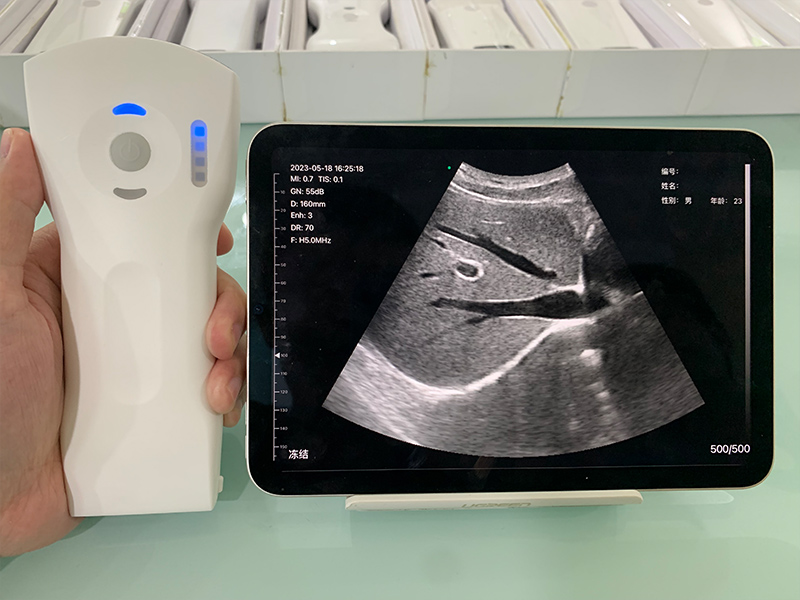
SonoStar Phased Array Probes Compared
| Specification | 6PA | 5PA |
|---|---|---|
| Scan mode | Electronic phased array | Electronic phased array |
| Elements / channels | 192 / 32 | 128 / 32 |
| Display modes | B, B/M, Color, PDI, PW, CW | B, B/M, Color, PW, CW, PDI |
| Frequency | 2.2 / 3.6 MHz | Central 2.8 MHz (cardiac harmonic 3.6 MHz) |
| Scan angle | 80° | 80° |
| Display depth | 90–200 mm | 90 / 160 / 200 / 240 mm |
| Frame rate | — | 15–20 frames/sec |
| Battery | 2600 mAh, ~2 h | ~1 h, USB charging |
| Charging | Wireless + USB | USB cable |
| Dimensions / weight | 135 × 40 × 25 mm / 120 g | 140 × 35 × 25 mm / 120 g |
| Screen compatibility | iOS, Android, Windows | iOS, Android, Windows |
How to choose: pick the 6PA for higher element count (192) and wireless charging plus a longer battery window; pick the 5PA if you prefer a deeper depth range (to 240 mm) and a lighter bill of features. Both stream to iOS, Android, or Windows and support color and spectral Doppler.

For department context, see SonoStar's Cardiology and Critical Care solution pages, or the emergency POCUS guide.
Buying Considerations for a Phased Array Handheld Ultrasound
Scan angle and depth range. ~80° sector and adjustable depth (90–240 mm) cover typical adult cardiac and shallow-abdominal windows.
Doppler modes. Color Doppler for flow and vessel orientation; PW/CW for velocity estimates. Confirm which modes the model supports.
Imaging extras. Harmonic imaging, dynamic range control, frame rate, and needle-guidance lines all add value at the bedside.
Battery and charging. Check working hours per charge and whether wireless charging is supported for your shift pattern.
Screen and workflow. Confirm iOS/Android/Windows support and that the app suits your documentation and sharing needs.
Total cost and support. Factor warranty, training, and any software costs alongside the price.
Frequently Asked Questions
What is a phased array handheld ultrasound used for?
Mainly cardiac and abdominal assessment at the point of care — cardiac windows, approximate ejection-fraction estimation, pericardial effusion, and lung or abdominal views — because its sector-shaped image fits through narrow acoustic windows between ribs.
How is a phased array different from a convex or linear probe?
A phased array produces a sector (pie-shaped) image from a small footprint, which fits between ribs for cardiac views. A convex probe produces a wide fan-shaped image for abdominal organs; a linear probe produces a rectangular image for superficial, vascular, and MSK work.
Does a handheld phased array ultrasound replace a full echo machine?
No. It is designed for focused bedside questions — approximate EF, pericardial fluid, gross chamber size — not for comprehensive, quantitative echocardiography. A full echo machine remains the standard for formal studies.
What specs matter when buying a phased array handheld ultrasound?
Key specs include scan angle, imaging modes (B, M, Color Doppler, and PW/CW Doppler), frequency and depth range, frame rate, battery life, and screen compatibility. A scan angle around 80° and support for CW Doppler are common expectations for cardiac use.
See the phased array difference
Explore SonoStar's phased array and multi-array wireless probes, or request a quote and demo.
View SonoStar Phased Array Probes →SonoStar (索诺星医疗) is a manufacturer of wireless handheld ultrasound probes, including phased array models 6PA and 5PA. Specifications reflect the product pages at sonostarmed.com. This article is educational and does not constitute medical advice; local credentialing, training, and regulatory requirements apply. Confirm current specifications with SonoStar before purchase.
- Pre:Best Handheld Ultrasound 2026: Buyer's Guide and Top Picks
- Next:No more




 Home
Home Product
 News
News Contact