


Linear-Array 3D Volumetric Hand-Held Ultrasound: Bringing High-End Volumetric Imaging to Point-of-Ca
- 2026-11-05
- 21
- Guangzhou Sonostar Technologies Co., Limited
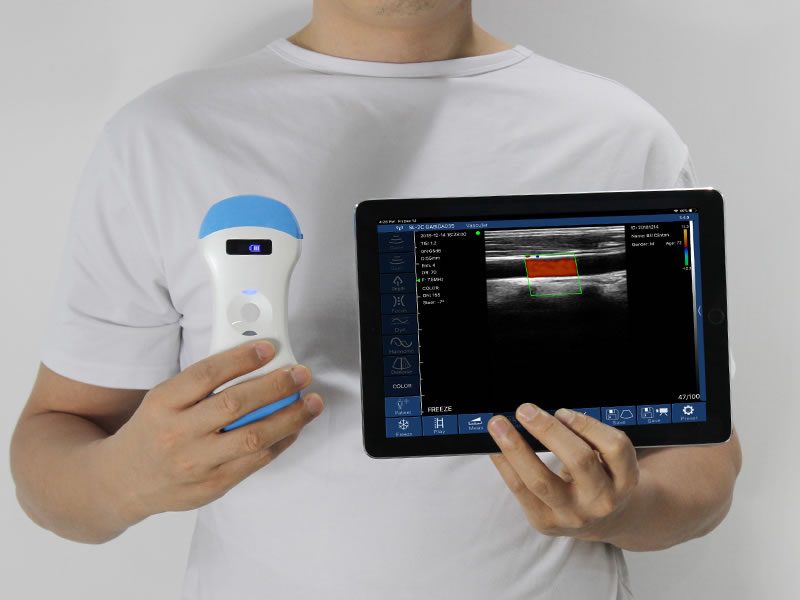
Traditional three dimensional ultrasound has long been confined to bulky cart based high end systems. These large devices require substantial capital investment and fixed examination rooms, making true volumetric imaging inaccessible for community clinics, bedside emergency assessments, aesthetic medicine departments and primary care sites. Clinicians often rely on sequential 2D cross sectional images and mentally reconstruct spatial anatomy, which heavily depends on operator experience and may risk missing critical volumetric information of superficial tissues. SonoStar’s linear array 3D volumetric hand held ultrasound breaks such industry bottlenecks, packing advanced volumetric reconstruction capability into a compact wireless probe that connects to smartphones or tablets to deliver both 2D scanning and real time 3D volumetric rendering.
This hand held ultrasound probe adopts electronic linear array transducer combined with built in mechanical swing and rotational scanning mechanism. It supports broad frequency bandwidth ranging from 2 MHz to 20 MHz, balancing high resolution 2D B mode imaging and automated three dimensional volume data acquisition. After completing scanning sequences, the internal hardware captures serial image slices and generates intuitive volumetric reconstruction, clearly visualizing tissue morphology, spatial extension, lesion scope and adjacent anatomical relations. Clinicians no longer need to mentally piece together sectional views; objective 3D visual outputs simplify diagnostic judgement and lower operator dependency of ultrasound examinationsPMC.

One standout advantage of this SonoStar device lies in its lightweight form and cost effective design. Compared with conventional large scale 3D ultrasound equipment, its cost rises only slightly versus standard 2D hand held probes. Free from cumbersome main units and tethered cables, the wireless probe supports replaceable batteries for extended clinical workflows. Compatible with Android, iOS and Windows terminals, it supports DICOM, JPG and MP4 data export for medical record archiving and remote consultation, enabling flexible deployment across hospital wards, outpatient consulting rooms, township health centers and aesthetic institutions.
It delivers extensive clinical value across multiple scenarios. For vascular practice, 3D reconstruction demonstrates overall vessel configuration and wall conditions to support vascular access evaluation and puncture planning. In orthopedics and rehabilitation, it visualizes injuries of muscles, tendons and superficial soft tissues with clear volumetric scope. Within aesthetic medicine, it evaluates the distribution and layering of subcutaneous fillers for objective post procedure follow up. Besides, it fits perfectly for emergency bedside triage and grassroots primary screening. Medical staff can carry the compact probe anywhere and acquire superficial 3D ultrasound images instantly, filling the gap of lacking volumetric devices at grassroots medical institutions.

For years, the clinical merits of 3D ultrasound have been well acknowledged, yet high costs and bulky hardware have hindered its wider penetration. As an innovator in compact ultrasound devices, SonoStar empowers more medical practitioners with accessible volumetric visualization via linear array 3D volumetric hand held ultrasound. It pushes superficial diagnosis from 2D cross section observation toward objective three dimensional assessment, reducing interpretation bias caused by individual operator variance. With the popularization of portable 3D ultrasound, medical facilities of varied scales can obtain premium volumetric imaging without massive capital expenditure, making advanced ultrasound technology accessible to more patients worldwide.
- Pre:Why Your Portable Ultrasound Images Look Poor — 8 Fixable Habits
- Next:No more




 Home
 Product
 News
 Contact